Rekayasa Biotray Berbasis Limbah Kulit Kakao dan Pati Tapioka sebagai Kemasan Makanan Biodegradable
Kata Kunci:
Kulit Kakao, Pati Tapioka, Biotray, BiodegradasiAbstrak
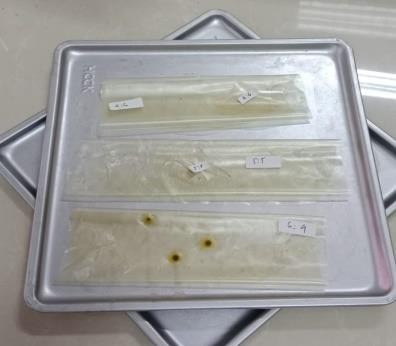
Tingginya pencemaran limbah plastik konvensional serta melimpahnya limbah kulit kakao yang belum termanfaatkan secara optimal mendorong perlunya inovasi kemasan pangan ramah lingkungan. Penelitian ini bertujuan merekayasa biotray biodegradable dengan memanfaatkan pektin dan lignin hasil ekstraksi kulit kakao yang dipadukan dengan pati tapioka. Formulasi dibuat dalam tiga variasi rasio pektin-lignin kulit kakao terhadap pati tapioka, yaitu perbandingan (m/m) 4:6, 5:5, dan 6:4. Karakterisasi produk meliputi uji ketahanan air, ketahanan panas, kuat tarik, elongasi, dan biodegradasi. Hasil penelitian menunjukkan bahwa peningkatan proporsi kulit kakao meningkatkan ketahanan air hingga 850%, ketahanan panas 0 %, serta kuat tarik mencapai 1,66 N/mm2, namun menurunkan nilai elongasi menjadi 8,0899 mm (59%) dan memperlambat laju biodegradasi. Terdapat hubungan berbanding terbalik antara peningkatan sifat fisik-mekanik-termal dengan kecepatan penguraian biotray yang memenuhi karakteristik dasar kemasan makanan ramah lingkungan.
Unduhan
Referensi
Agarwal, S. (2021). Major factors affecting the characteristics of starch based biopolymer films. European Polymer Journal, 160, 110788. https://doi.org/https://doi.org/10.1016/j.eurpolymj.2021.110788
Ali, Z., Abdullah, M., Yasin, M. T., Amanat, K., Ahmad, K., Ahmed, I., Qaisrani, M. M., & Khan, J. (2024). Organic waste-to-bioplastics: Conversion with eco-friendly technologies and approaches for sustainable environment. Environmental Research, 244, 117949. https://doi.org/https://doi.org/10.1016/j.envres.2023.117949
Barrios-Rodríguez, Y. F., Salas-Calderón, K. T., Orozco-Blanco, D. A., Gentile, P., & Girón-Hernández, J. (2022). Cocoa Pod Husk: A High-Pectin Source with Applications in the Food and Biomedical Fields. ChemBioEng Reviews, 9(5), 462–474. https://doi.org/https://doi.org/10.1002/cben.202100061
Cabrera, S. F., Pighin, A., Chiana, M. L., Passeggi Jr., M. C. G., Ruano, G. D., Gugliotta, L. M., Ronco, L. I., & Minari, R. J. (2022). Synergistic combination between starch and proteins in the synthesis of new acrylic/biopolymers hybrid latexes. Journal of Polymer Science, 60(24), 3420–3434. https://doi.org/https://doi.org/10.1002/pol.20220107
Campos-Vega, R., Nieto-Figueroa, K. H., & Oomah, B. D. (2018). Cocoa (Theobroma cacao L.) pod husk: Renewable source of bioactive compounds. Trends in Food Science & Technology, 81, 172–184. https://doi.org/https://doi.org/10.1016/j.tifs.2018.09.022
Chen, Y., Wang, J., Xu, L., Nie, Y., Ye, Y., Qian, J., Liu, F., & Zhang, L. (2024). Effects of Different Plasticizers on the Structure, Physical Properties and Film Forming Performance of Curdlan Edible Films. In Foods (Vol. 13, Issue 23, p. 3930). https://doi.org/10.3390/foods13233930
Davidson, D. J., Lu, F., Faas, L., Dawson, D. M., Warren, G. P., Panovic, I., Montgomery, J. R. D., Ma, X., Bosilkov, B. G., Slawin, A. M. Z., Lebl, T., & Chatzifragkou, A. (2023). Organosolv pretreatment of cocoa pod husks: isolation, analysis and use of lignin from an abundant waste product. American Chemical Society Sustainable Chemistry & Engineering, 11(39), 14323–14333. https://doi.org/10.1021/acssuschemeng.2c03670
Holguín Posso, A. M., Macías Silva, J. C., Castañeda Niño, J. P., Mina Hernandez, J. H., & Fajardo Cabrera de Lima, L. D. (2024). Characterization and Implementation of Cocoa Pod Husk as a Reinforcing Agent to Obtain Thermoplastic Starches and Bio-Based Composite Materials. In Polymers (Vol. 16, Issue 11, p. 1608). https://doi.org/10.3390/polym16111608
Jeong, C.-H., Lee, S.-H., & Kim, H.-Y. (2022). Analysis of Food Storage Stability of Biodegradable Containers Made of Pork Skin Gelatin Polymer with Walnut Shell Powder. In Polymers (Vol. 14, Issue 10, p. 1940). https://doi.org/10.3390/polym14101940
Meza-Sepulveda, D. C., Hernandez-Urrea, C., Sanchez Rivera, J. P., & Agudelo Serna, L. D. (2025). Biocomposite film formulated with cellulose extracted from cocoa pod husk. Cellulose, 32(13), 7591–7602. https://doi.org/10.1007/s10570-025-06642-4
Nguyen, V.-L., Tran, M.-T., Nguyen-Thi, T.-D., Nguyen, M.-A., Le, M.-T., Nguyen, T.-M., & Nguyen, Q.-D. (2024). Valorization of cocoa (Theobroma cacao L.) pod husks as a fruit pulp substitute in mango jam formulations: effects on jam qualities during storage and sensory discrimination††Electronic supplementary information (ESI) available. See DOI: https://doi.org/10.1039/d4fb00331d. Sustainable Food Technology, 3(1), 333–342. https://doi.org/https://doi.org/10.1039/d4fb00331d
Nurazizah, Amraini, S. J., & Bahruddin. (2019). Pengaruh sorbitol terhadap karakteristik bioplastik berbasis pati sagu-polivinil alkohol (pva) dengan menambahkan kitosan sebagai. Jurnal Online Mahasiswa (JOM) Bidang Teknik Dan Sains, 6, 1–8.
Nurhadianty, V., Setiadi, T., Handojo, L. A., & Putrawan, I. D. G. A. (2026). Ambient ultrasound-assisted extraction of pectin from cocoa pod husk using tartaric acid and evaluation of its film-forming properties. South African Journal of Chemical Engineering, 58, 100990. https://doi.org/https://doi.org/10.1016/j.sajce.2026.100990
Nurhidayat, Tamrin, & Asyik, N. (2023). Ekstraksi dan Karakterisasi Pektin Pada Kulit Buah Kakao (Theobroma cacao L.) Berdasarkan Perbedaan Tingkat Kematangan Buah. Jurnal Riset Pangan, 1(1), 78–95.
Prastyawati, S., & Sriyana, H. Y. (2024). Sintesis Plastik Biodegradable Dari Pati Ganyong Dengan Modifikasi Kasein Susu Afkir Dan Plasticizer Sorbitol Synthesis Of Biodegradable Plastic From Canna Starch With Modification Of Afkir Milk Casein And Sorbitol Plasticizer. 6(2), 61–71.
Raajeswari, P., Manivel, D., Dhanapal, A. C. T. A., Menkinoska, M., Pavlovska, G., Helal, M., Sami, R., Alsanei, W. A., Alessa, F. M., Trajkovska Petkoska, A., & Qari, S. H. (2025). Sustainable biodegradable tapioca starch films enhanced with basil oil, carboxymethyl cellulose, and citric acid for functional food packaging applications. Frontiers in Sustainable Food Systems, Volume 9-2025. https://doi.org/10.3389/fsufs.2025.1610769
Ricra, O., Liviac, D., & Reategui, O. (2026). Evaluation of the Biodegradability of Plastic Polymers Made From Residual Cocoa Husk (Theobroma cacao L.) and Cassava Starch (Manihot esculenta), Lima, Peru. Advances in Materials Science and Engineering, 2026(1), 6017152. https://doi.org/https://doi.org/10.1155/amse/6017152
Riseh, R. S., Vazvani, M. G., Hassanisaadi, M., & Thakur, V. K. (2024). Agricultural wastes: A practical and potential source for the isolation and preparation of cellulose and application in agriculture and different industries. Industrial Crops and Products, 208, 117904. https://doi.org/https://doi.org/10.1016/j.indcrop.2023.117904
Versino, F., Ortega, F., Monroy, Y., Rivero, S., López, O. V, & García, M. A. (2023). Sustainable and Bio-Based Food Packaging: A Review on Past and Current Design Innovations. In Foods (Vol. 12, Issue 5, p. 1057). https://doi.org/10.3390/foods12051057
Yesika, R., Andika, M., Desnita, E., & Marsellinda, E. (2025). Efek Analgetik Ekstrak Etanol Daun Afrika (Vernonia Amygdalina Del.) pada Mencit Putih Jantan dengan Metode Writhing Reflex Test: Analgetic Effect of Etanol Extract African Leaves (Vernonia Amygdalina Del.) on White Rats Using Writhing Reflex Test Method. JURNAL FARMASI DAN MAKANAN, Vol 8 No 2 (2025): Journal of Pharmacy and Science, 181–187.
Unduhan
Diterbitkan
Cara Mengutip
Lisensi
Hak Cipta (c) 2026 Ririn Tri Noviana, Gabriel Pratama Tondolipu, Ni Made Kesumasari (Penulis)

Artikel ini berlisensiCreative Commons Attribution-NonCommercial-ShareAlike 4.0 International License.